




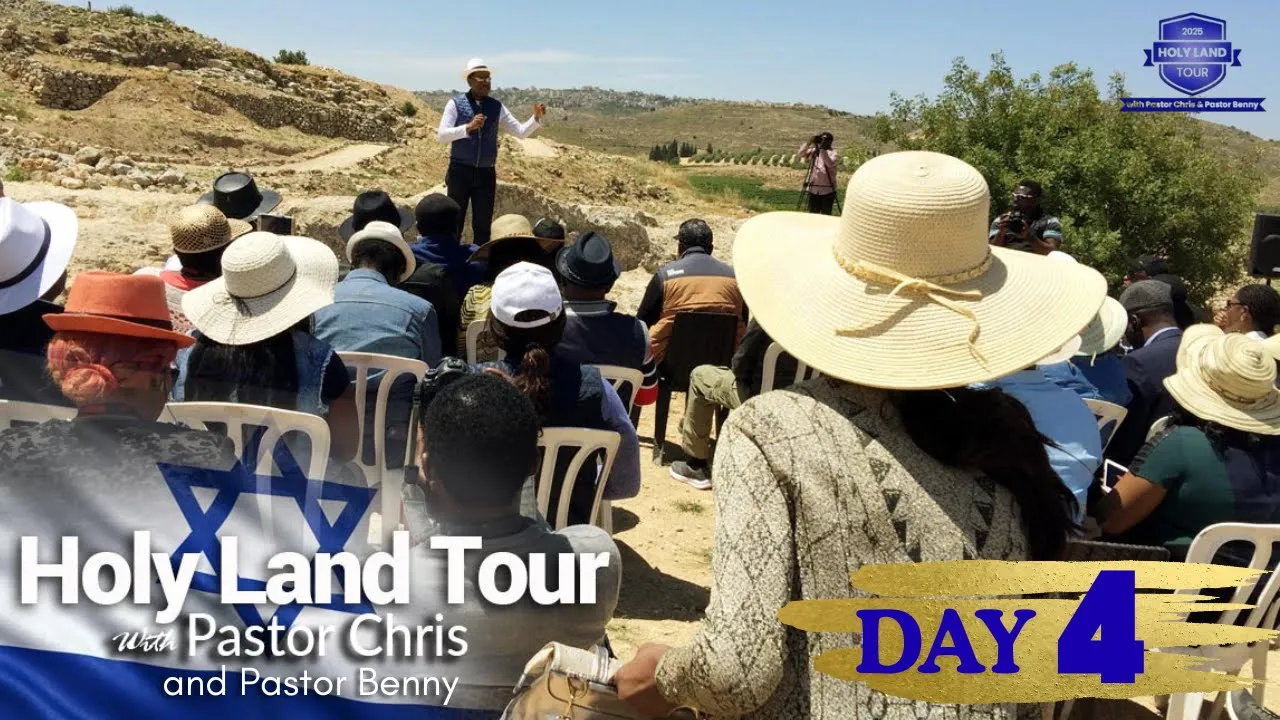
Grande Finale Live: Holy Land Tour by Pastor Chris Oyakhilome: Sermon Notes
With Pastor Benny
lightbulb Message Summary - Key Nuggets
- The word of God is defined as the message from God that reveals His will and builds His image into those who hear it.
- Understanding who the biblical author addresses in a passage is essential to correct interpretation — context prevents misreading Scripture.
- The anointing every believer receives gives a general awareness of truth, enabling even young Christians to discern what is not of God.
- Growing in grace and knowledge of Jesus Christ is not optional — it is the path toward Christian perfection and fullness of glory.
Notes/Excerpt
These notes were taken while listening and may contain some errors. Please tap any sentence twice to suggest corrections.
By holding or selecting a paragraph, you can easily share snippets to friends or on your whatsapp status directly
What Is the Word of God?
Testimonies are important in the kingdom of God. Beyond testimonies, however, what shapes a believer's life is hearing, studying, and meditating on the word of God.
A definition shared during this session describes the word of God as: that message from God that reveals or communicates His works, will, thoughts, plans, purposes, and pursuits to bring men into — or promote — fellowship with Him in love. It is His message of truth with the content and power to build His image into the life of the hearers. Its content is the embodiment of Christ's revelations, provisions, perfections, and instructions.
Not everything preached from a Bible reading constitutes the word of God. There must be that quality of divine communication that actually reveals and imparts. This distinction matters deeply.
Context: Who Is Being Addressed?
The text for this session is 1 John 2:20 — "But ye have an unction from the Holy One, and ye know all things." And 1 John 2:27 — "But the anointing which you have received of him abideth in you, and ye need not that any man teach you; but as the same anointing teacheth you of all things, and is truth, and is no lie, and even as it hath taught you, ye shall abide in him."
The same Greek word is used for both "unction" and "anointing" in these two verses.
Before drawing any meaning from 1 John 2:20, the first question to ask is: who is John addressing? Context determines everything. Reading without knowing the audience produces misunderstanding.
The Greek Categories of Spiritual Growth
In 1 John 2:12–14, John addresses three distinct groups. To properly understand them, key Greek terms must be noted:
- Paidion — little boys and girls; children who can receive instruction and direction. These are newer believers, young in faith.
- Neoniskus — youth; young men and women, adolescents strong in the word.
- Pater — fathers; those who have known Him from the beginning.
notifications_active Stay Updated
Join the Readsermons communities for daily nuggets and new sermon alerts.
Two other related words help clarify:
- Brephos (used in 1 Peter 2:2) — newborn infants, those just born again, hungry for the milk of the word.
- Nepio (used in 1 Corinthians 3:1–3) — a child by reason of inability to speak intelligently; unskilled, untaught. Paul uses this for carnal believers who could not yet receive solid food because envy and strife still marked their walk.
In 1 John 2:12–14, John is addressing all three groups. He tells the fathers he is writing because they have known Him from the beginning. He tells the young men they are strong because the word of God abides in them and they have overcome the wicked one. Then in verse 15, he addresses the young men specifically: love not the world, neither the things that are in the world. This is a temptation peculiar to youth.
From verse 18, he turns to the paidion — the little children — warning them about antichrists who have gone out from among them.
The Anointing and What "Know All Things" Means
Verse 20 is addressed to the little children (paidion): "But ye have an unction from the Holy One, and ye know all things."
The Greek word for "know" here is eido — awareness, not deep revelatory knowledge. This is distinguished from:
- Ginosco — to know by personal acquaintance, as in John 8:32: "And you shall know the truth, and the truth shall make you free." This is an intimate knowing.
- Epiginosco — full, thorough, experiential knowledge; to know completely through relationship and use.
)
Pastor Chris Oyakhilome
LoveWorld Incorporated, also known as Christ Embassy
Enjoying this sermon? Browse more messages by Pastor Chris Oyakhilome on Holy Spirit at ReadSermons.
The illustration: someone sends you a wrapped gift from the United States. You are aware (eido) that a gift has arrived. You do not yet know (ginosco) what it is — until you open it. When you begin to use it and understand everything about how it works, that is epiginosco.
So when John says the little children "know all things," he means they have a general awareness — given to them by the anointing — that enables them to discern truth from error even without having studied the whole Bible. The anointing gives that general orientation toward God.
This awareness is prophesied in Jeremiah 31:31–33, the new covenant promise: "I will put my law in their inward parts and write it in their hearts... and they shall teach no more every man his neighbour, saying, Know the Lord: for they shall all know me, from the least of them unto the greatest of them." The Spirit bears witness with the believer's spirit — even a new believer instinctively knows that certain things are not of God.
Does "No Man Teach You" Mean No Teachers?
1 John 2:27 says the anointing teaches all things and the believer needs no man to teach them. This cannot be taken to mean human teachers are unnecessary — that would contradict the rest of Scripture.
1 Corinthians 12:27–29 declares that God has set in the church first apostles, then prophets, then teachers. Colossians 2:7 says believers are rooted and established in faith "as ye have been taught." 2 Thessalonians 2:15 instructs believers to stand fast and hold to traditions taught "whether by word or our epistle." Ephesians 4:11–13 shows that God gave apostles, prophets, evangelists, pastors, and teachers for the perfecting of the saints, until they come to the measure of the stature of the fullness of Christ — and this must happen in this world through teaching.
Christian perfection is a real biblical truth. As long as leaders say "I am not perfect, I am just trying," both they and their congregations will remain in spiritual babyhood. The instruction is clear: grow in grace and in the knowledge of our Lord and Savior Jesus Christ (2 Peter 3:18). The more one knows Him, the more one becomes like Him.
2 Corinthians 3:18 reveals the mechanism: beholding the glory of God is what causes transformation from glory to glory. The progression is grace to grace, then faith to faith, then glory to glory — ever increasing, never static.
The Ministry of the Holy Spirit and Spiritual Levels
You may also like

Contending For The Faith (the Pathway To Maturity)
by Apostle Joshua Selman
One of the most troubling patterns among God's people is the unconscious relegation of the Holy Spirit's ministry. Most have never investigated what it truly means to be filled with the Holy Ghost.
Key distinctions must be understood across believers:
- Faith — Every believer receives the same measure of faith at salvation (Romans 12:3). But faith grows by hearing the word of God, and is strengthened by using it. Those with little faith, strong faith, or great faith differ only in how much they have grown and exercised theirs.
- Grace — Believers receive different measures of grace, yet more is available to be received. Promotion and new assignments require more grace. The grace to pastor 500 is not the same as the grace needed for 5,000 (James 4:6).
- Gifts — The Spirit divides gifts as He wills, though believers may earnestly desire the best gifts (1 Corinthians 12:31).
- Calling — Paul was called to the Gentiles; Peter to the Jews. Each calling determines what God requires within it.
- Office/Ministry — The office of a pastor, the office of an apostle — these are distinct and carry specific functions.
Yet the Holy Spirit Himself is the same for all. John 3:34 states that God does not give the Spirit by measure — at least not to the one who is after the second Adam, Jesus Christ. The believer does not receive a partial Spirit.
Stirring Up the Gift of God
The example of Timothy in 2 Timothy 1:1–7 is instructive. Paul writes to Timothy with deep affection. He recalls the unfeigned faith in Timothy — a faith that was first in his grandmother Lois and his mother Eunice. Paul says he is persuaded it is in Timothy also.
Yet Paul adds: "I put thee in remembrance that thou stir up the gift of God which is in thee by the putting on of my hands." Then in verse 7: "For God hath not given us the spirit of fear; but of power, and of love, and of a sound mind."
The situation: Paul had laid hands on Timothy and imparted something, but he was not seeing the results. Timothy himself was not walking in it. The gift had been given but it was dormant.
The gift of the Holy Spirit — not just one of the gifts of the Spirit, but the person of the Holy Ghost Himself — must be stirred up. The instruction is: stir up that gift. How? Pray until your mind is no longer in control — until your spirit is. The best way to do this is praying in the spirit, praying in tongues. The more one prays in the spirit, the more conscious of the spirit one becomes. Eyes open. Ears open. One begins to see what others cannot see and hear what others cannot hear.
Being Filled Through Your Whole Being
Ephesians 5:18 commands: "Be not drunk with wine, wherein is excess; but be filled with the spirit."
Being filled with the spirit can happen in stages through the three parts of a person:
- The spirit — where the Holy Ghost takes up residence first.
- The soul — the seat of will, mind, and emotions.
- The body — the flesh and its senses.
On the day of Pentecost, the disciples appeared drunk because the Spirit had reached their physical bodies. When the Spirit gets to the body, something tangible happens. Romans 8:10–11 explains it: "And if Christ be in you, though the body be dead because of sin, the spirit gives it life because of righteousness." Then verse 11: "But if the Spirit of him that raised up Jesus from the dead dwell in you, he that raised up Christ from the dead shall also quicken — vitalize — your mortal body by his Spirit that dwelleth in you."
This is God's answer to sickness. When the Spirit reaches and permeates the physical body, a self-healing process is activated. Practice being filled with the Holy Ghost every day — through the spirit, through the soul, through the body. When it reaches the body, something is felt. It has not failed to happen. It surges through. Sometimes it remains for days. It does something to the physical body that cannot be fully described.
Practice it consistently. It will keep the heart in the right condition. The kidneys. The blood circulation. The lungs. The brain. Every organ. People who practice this do not need to seek healing for conditions in their body — the self-healing process is already at work.
The life that God gave you in Christ Jesus supplants the human life you were born with. You are not born additionally — you are born again. You have one nature: the nature of God. Christ is in you, the hope of glory — glory realized. Let the divinity in you swallow up the humanity in your mind. You have received a new life. Let that new nature inundate you completely. You live by the law of life. I function by the law of life. If there is an injury, it heals quickly. If there is pain, it must go. This is the life of God at work in you.

Pastor Chris Oyakhilome
LoveWorld Incorporated, also known as Christ Embassy
Enjoyed this sermon? Browse more messages by Pastor Chris Oyakhilome on ReadSermons.
Comments
0 comments
No comments yet. Be the first to share.
Stay updated with Readsermons
To be notified on every sermon release, join the group that suits you best:
For nuggets & Sharable snippets follow us.