




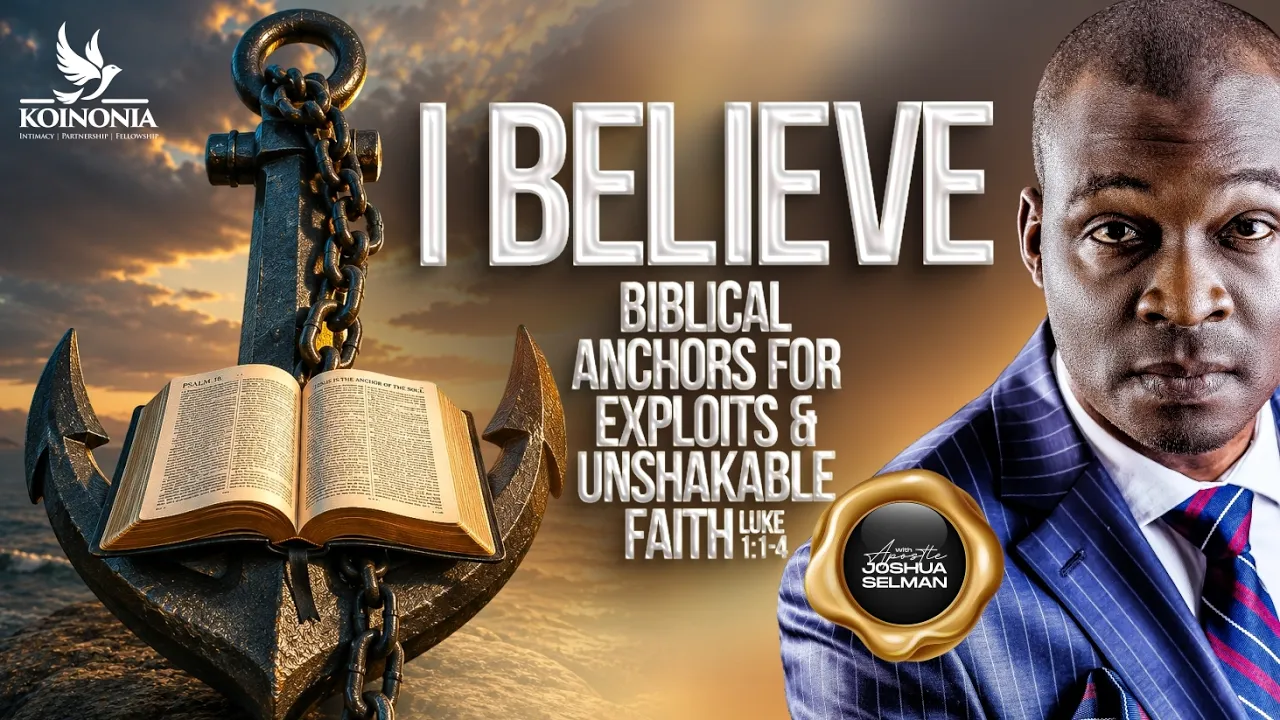
I Believe (biblical Anchors For Exploits And Unshakable Faith) by Apostle Joshua Selman: MP3 Download & Sermon Notes
Anchors Keep The Ship Unshaken
lightbulb Message Summary - Key Nuggets
- The church in the north must embrace meekness to receive impartation.
- Pride blocks transference of grace between believers.
- Unshakable faith rests on at least ten scriptural anchors.
- Believing in God's existence and supremacy is the first anchor.
- Scripture's integrity reveals God, salvation, and the believer's destiny.
Notes/Excerpt
These notes were taken while listening and may contain some errors. Please tap any sentence twice to suggest corrections.
By holding or selecting a paragraph, you can easily share snippets to friends or on your whatsapp status directly
The Problem of Pride and Familiarity
The average African often comes from a background of deprivation, and this can produce a sense of embarrassment about acknowledging help received from others. Some would rather attribute their growth to their own effort than admit they were helped, and this pride is destroying the program of God.
- Transference cannot happen in the presence of pride. You cannot receive in the presence of pride.
- Grace given to a person is meant for the edification of the church, not just personal advancement.
- God will not give an assignment that is beyond present capacity, because it would destroy the one entrusted with it.
There is a Nigerian slang called "see finish," meaning overfamiliarity. This mentality must be dropped for spiritual growth to happen. Many young people carry deep grace, but factors like age, family ties, and academic relationships get in the way. A person can be a pastor while their mother serves under them, and they understand the difference between the family relationship and the spiritual order. This must be learned.
Whereas there are those who carry a healing anointing in their own regions, they would rather minister to people outside while those close to them receive nothing. This mentality of familiarity, combined with pride, is a cancer destroying people.
The spirit of God is crying out again that he wants to move mightily in the north. There are many prophetic psalmists and worshippers who should have risen from the north, but limitation persists where those meant to mentor and train them refuse to open up.
Balance: A Word to Those in Positions of Influence
If you are a pastor or occupy a position of influence, do not rub it in people's faces because God has lifted you. People should not have to grovel to prove your greatness. If God has granted access to finances, be grateful, but know it is not easy for people to keep celebrating you without you reaching down. This is the law of reciprocity.
A little lifting, a little exposure, and some want people to roll around and worship them as a sign of breakthrough. That is not the culture of the kingdom. God works on the character of men so that as they rise, they do not become a destructive influence to those looking to them.
However, do not trivialize greatness when you see it. Do not see God using men doing great and mighty things and get angry, resentful, and search for something bad to downplay it. Nobody becomes sustainably great by mistake. That you do not understand the dynamics does not mean it was not done properly.
Genesis 4
Cain and Abel each brought an offering. One was accepted, the other was not, because one did what was right and the other did not. Cain got angry, but the standard for acceptance was doing what was right.
- Father, help your people, every pastor, prophet, apostle, missionary, and evangelist across the north.
- We decree a baptism of meekness upon those who do the work of ministry, extending to politicians and business people.
- Let there be malleability of heart to receive dimensions not yet possessed, without embarrassment.
- Take away the spirit of familiarity that cuts short the potential for growth.
- Let the pastors God is using be humble enough to reach down to those below them.
- Let your prophetic word over the church in the north come to pass.
There is going to be a great awakening. There is going to be a great revival in this land. Everyone who calls on Jesus will be saved.
I Believe: Biblical Anchors for Exploits and Unshakable Faith
Reflecting on the growth seen among believers compared to the level of teaching given, there is real gratitude for the transformation taking place as the Holy Spirit finds unrestrained access to hearts. The commitment remains to build believers methodically, line upon line, precept upon precept, so that every gathering becomes an encounter imparting knowledge, wisdom, and the empowerment needed to keep rising.
2 Corinthians 9:6 speaks of sowing bountifully to reap bountifully; some believers grow thirtyfold, sixtyfold, a hundredfold, according to their diligence in becoming. 1 Timothy 4:15 instructs believers to meditate on these things and give themselves wholly to them, that their progress may be evident to all.
notifications_active Stay Updated
Join the Readsermons communities for daily nuggets and new sermon alerts.
This teaching looks at the biblical anchors for a life of exploits and unshakable faith. Scripture calls believers to be steadfast and immovable, like a ship that must be anchored. Certain foundational truths of the Christian faith must become that anchor.
Luke 1:1-4
Luke's opening explains that many had taken in hand to set forth a declaration of the things most surely believed, delivered by eyewitnesses and ministers of the word, so that the reader might know the certainty of what he had been taught. What believers have been shown are not opinions, not subjective thoughts, not cunningly devised fables.
Colossians 2:6-7
Paul instructs the church at Colossae to walk in Christ as they received Him, rooted and built up in Him, established in the faith as they were taught, abounding in it with thanksgiving. Faith should not be mere information; it should be rooted and built up as a result of what has been taught and established.
There are at least ten anchors upon which a believer must peg conviction if faith is to stand the test of time and remain unshakable. An anchor sustains the capacity to hold a ship steady regardless of the boisterous movement of wind and sea. Denominational differences exist, but these ten anchor truths must be held by any Christian life that intends to be unshakable, especially in these times, and to produce lasting victory. Failing to hold to even some of them produces a defeated or frustrated Christian, one whose life cannot present God in a way that compels others to come to Him.
There is a real and growing tendency for believers who once purported to love God to suddenly abandon that conviction, whether through a defiant teaching, a change of environment such as travel abroad, or exposure to advanced study. Some who serve for decades as pastors eventually declare they no longer believe, tired of what they see as pretending. Others are swayed within months of encountering a culture where Christianity is not dominant. Others let philosophy and sociology reshape their view of what they once considered ignorance. Still others are moved by highly intelligent people who are angry at God, weaving thought-provoking arguments about the deity of Christ, eternal judgment, or why a good God allows suffering, until a listener begins to agree that "something is wrong." When such questions are brought to a pastor and met only with "don't disrespect me" rather than an answer, it leaves believers with borrowed rather than examined convictions.
Ministry has allowed the study of other world religions, and it is striking how convincing intelligence can be, even when it leads nowhere. As believers rise into rooms where they may be the only Christian present, and others come prepared with their own arguments, blind conviction is no longer sufficient. Especially for pastors, calling oneself a pastor implies being equipped to defend the faith intelligently.
Believing something and merely wishing, thinking, or still contemplating it are not the same thing. This is what it means to say "I believe."
The Existence and Supremacy of God
John 17:3, 1 Timothy 1:17, Romans 1:16, Genesis 1:1
A believer must believe in the existence and supremacy of God. Scripture affirms this from the very first verse, and Romans explains that God's invisible qualities, His eternal power and divine nature, have been clearly seen through what has been made, leaving no one without excuse. The ability to see the stars, the sea, great creatures, human beings, animals, and trees should convince anyone that there is an eternal Creator.
- God can mean many things in Scripture, including a person's own belly, an idol, or self; but here God means God Almighty, the only true God, revealed alongside Jesus whom He sent.
- He is described as the King eternal, immortal, invisible, the only wise God, the God of heaven and earth, the Ancient of Days.
- Belief in His existence and supremacy is what makes it possible to believe that He can empower men and open doors; no one can trust what God can do until they are certain He is alive.
This conviction will be tested, particularly when prayers seem unanswered, when a loved one is dying, or when life stops working as expected. No matter what happens, this conviction must never be abandoned: God is alive, He is God Almighty, the King eternal, immortal, invisible.
The Supremacy and Integrity of the Word of God
2 Timothy 3:16-17
The word "Bible" comes from the Greek word for "book." Scripture contains all kinds of writings: God spoke in it, but so did Satan, and so did men under both the Holy Spirit's influence and demonic influence. This does not mean everything said within its pages was itself inspired by God, but that the capturing of those statements was inspired, because it is profitable. Even the recorded conversation between Jesus and Satan in Matthew 4 was documented for this reason.
- Scripture is profitable for doctrine, a body of knowledge able to move a student to the place of a teacher.
- It is also profitable for reproof or rebuke; certain stories, such as Solomon's account in Ecclesiastes, do not carry doctrinal benefit but exist to correct.
- It is profitable for correction and for training in righteousness, so that the man of God may be thoroughly equipped for every good work.
Scripture's authority does not rest on historical or archaeological accuracy, since translation errors and human depravity in the text exist; its accuracy rests in its ability to reveal God, the plan of salvation, Jesus Christ, and the believer's destiny in Christ. Written by more than forty authors across generations who never met one another, including four hundred years of prophetic silence between Malachi and the Gospels, the Bible reads as a single unfolding line from Genesis to Revelation, a fact impossible to fake by coordination.
personlibrary_books More SermonsApostle Joshua Selman
Enjoying this sermon? Browse more messages by Apostle Joshua Selman on Faith at ReadSermons.
Whether Scripture is read from a printed book or from a phone, it should not be idolized as an object. It is a very intentional compendium inspired by the Holy Ghost, not merely a book with verses inside it.
The Person and Ministry of the Holy Spirit as the Believer's Advantage
John 16:8, John 16:12-13, Acts 5:3-4, Psalm 104:30, John 16:8-11, Isaiah 61, Micah 3:8, Acts 1:8
The Holy Spirit is one of the expressions of the triune Godhead, as seen when Peter rebukes Ananias for lying to the Holy Ghost and calls it lying to God Himself. The Holy Spirit has a three-fold ministry: to creation, to unbelievers (convicting them and bringing them to Christ), and, most significantly, to believers.
- To believers He provides guidance and direction, and reveals the will and the word of God.
- He confirms the word; every time the word of God is spoken, it is the Holy Ghost who breathes upon it and brings confirmation.
- He represents the voice of God and is the custodian of the anointing, both the conveyor and administrator of the life of God in man.
Even before the Holy Ghost's dispensation began, miracles already existed, but they were not enough on their own to convince people to believe in Jesus. Feeding thousands, walking on water, raising the dead, and even His own resurrection still left room for doubt. Miracles are powerful, but there is a work of the Holy Ghost in the heart that convinces beyond physical evidence, beyond what logic or science can explain. It is the Holy Spirit who bears witness with a believer's spirit.
Belief in the Holy Spirit's ministry goes far beyond speaking in tongues. It takes the Holy Ghost for a man to willingly lay down his life for Jesus, and it takes the Holy Ghost to move someone to give sacrificially. Looking back over a life of ministry, much of what was accomplished would have been foolish to attempt apart from the Holy Ghost; only in hindsight does it become clear how impossible certain crossings truly were.
The Finished Work of Christ and the Believer's Identity
Ephesians 1:7
The finished work of Christ refers to the victory purchased for the believer through His death, burial, resurrection, ascension, and exaltation, along with every implication that follows. Misunderstanding this anchor distorts a believer's concept of deliverance, warfare, Satan, and victory, and blocks the ability to walk in dominion.
- Jesus came as the incarnate one, born of the Virgin Mary, growing as any other person, beginning public ministry at thirty.
- Paul and Peter, under the influence of the spirit of revelation, gave the church a thorough exposition of what Christ's death accomplished: not merely that He died for believers, but that believers died in Him, were resurrected in Him, and are today seated in Him. Ephesians 1:7 speaks of redemption and forgiveness of sins according to the riches of His grace.
- Because Jesus prevailed over death, hell, and the grave, the lamb that was slain is the lion who reigns. Christ went to the place of the dead and, according to Peter's account, preached to the souls held there, releasing the patriarchs who had died believing in the promise of salvation, becoming the firstborn among the many now born again.
- He then ascended to fulfill a high priestly duty, offering His own blood once and for all in the true tabernacle, unlike the Old Testament pattern where an unblemished lamb no older than a year secured only a temporary atonement. Jesus, as the ageless lamb, purchased eternal redemption.
When Jesus said, "It is finished," He meant it is finished. Whether or not something has yet manifested in a believer's life, it can manifest precisely because it is already finished: victory over demons, curses, and failure are already accomplished facts. The cross and the blood are a summary of at least seven victories: over sin, Satan, death, hell, the grave, the world, and the flesh. The way this manifests may differ from situation to situation, but it remains true because it is finished. Carrying this "finished" mentality changes how a believer prays; rather than asking God to act as though nothing has yet happened, the posture becomes one of calling for what is already finished in Christ to be made visible.
This same finished work also produced a new identity. Scripture describes a merging of Jew and Gentile into one new man, so that the believer is called a new creation, someone in Christ who reckons himself accordingly, the old things having passed. Among the identities that follow are:
- Being a child, or son, of God, in a genderless sense of relationship.
- Being called the righteousness of God in Christ.
- Having a positional advantage, seated with Christ in the heavenly realm.
- Having oneness with Christ as the vine and the believer as the branch, one spirit with Him.
- Being the beloved of God, a truth that does not empower license but removes fear, since no relationship, with God or with people, can flourish where fear governs it.
The revelation of being God's beloved changes how a believer responds to failure. Coming boldly, not arrogantly, before God means running to Him rather than away from Him when something goes wrong.
The Reality of Spiritual Laws, Principles, and Protocols
Job 38:33, Deuteronomy 28:1, Joshua 1:8, John 3:16, Romans 10:8-10, Ephesians 1:3
You may also like

How To Fast (part 1)
by Pastor Dolapo Lawal
arrow_forwardStopping at the first four anchors will leave a Christian life proposing lofty things without ever experiencing them. There are two dimensions to spiritual realities: the prophetic dimension, what has already been finished in Christ, and the appropriation system, the laws and protocols that convert those finished realities into experiential manifestation. Healing and health, for example, are finished in Christ, but may not yet be manifest in a believer's life until the relevant law of conversion is engaged.
- Obedience to what God commands invites His glory to appear, and diligent hearkening to His voice brings blessings that overtake the obedient.
- Meditating on the word day and night in order to observe and do it is what makes one's ways prosperous.
- Salvation itself illustrates the pattern: though finished in Christ, it is not automatically imputed to every person, but requires engaging the appropriate kingdom protocol: believing on Him, confessing His lordship, and believing in the heart that God raised Him from the dead.
No one is condemned eternally because of sin alone; condemnation comes from rejecting Jesus, since He made the new and living way. Believing His lordship at that instant brings the forgiveness of sin, the imputed righteousness of God in Christ, and access to the life of God, or Zoe. This same pattern of appropriation applies to every other provision in the kingdom, including healing and breakthrough, though the mechanics differ: healing responds to the hearing of faith and the response of obedience, while wealth responds to diligence, relationships, investment, and giving.
Knowing the promises is not enough; the appropriation systems themselves must be learned, which is why mentorship and a teaching priest matter. Favor, breakthrough, and increase are not running away from anyone; they are running away from ignorance, in the same way a person can sit in a house full of provision yet not know how to operate what is already available to them.
The Priesthood Ministry of the Believer
Luke 18:1, 1 Thessalonians 5:17, Mark 11:24, James 5
Every believer in Christ is a king-priest, and this priesthood includes, but is not limited to, prayer, intercession, and fellowship with the Holy Ghost and with other believers. There is no rising, no manifesting dominion, and no lasting victory over demons, principalities, and negative forces apart from an active prayer life; anything that makes a believer disregard or disrespect prayer, however sincerely framed, effectively signs that believer up for perpetual defeat.
- Prayer is not reserved for prayer-department members or "warfare giants"; it is for all believers.
- Prayer is not the only key to every door, but it is involved in the opening of any door; where it is not the key itself, it becomes the hand that holds the key.
- Prayer carries at least a four-fold assignment: growth and transformation, receiving answers to petitions, creation and spiritual legislation, and warfare and prophetic intercession.
An attack on a believer's prayer life is a real attack and should be resisted rather than dismissed. Principles alone only hold when there is no demonic resistance to them; where an equation like one plus one meets a demonic attack, the outcome is no longer guaranteed by principle alone. Paul himself noted that a great and effective door was open before him even though many adversaries opposed it, showing that a stronger priesthood is required the higher one rises, since rising invites a clash of altars. An altar is not merely something carved from stone; it is the system that authorizes possibilities in a life, and without a functional prayer altar it becomes difficult to rise.
The Power of Christlike Character
Galatians 5:16-22, Colossians 3, Colossians 4, Ephesians 4
A refined believer cannot afford to be careless about Christlike character, commonly described as the fruit of the Spirit. These passages together give the coordinates of biblical character, and Paul devoted considerable space in Ephesians to the excellency of a godly character.
- It is possible to profess that everything is finished in Christ while still behaving in a way inconsistent with that profession; receiving breakthrough or finances in Christ should not come without also receiving the transformation that Christ intends.
- The first assignment of the anointing is not to empower a person's gifting, but to make that person Christlike. Every background carries inherited behavioral traits, many of them contrary to Christ, and submitting to the washing of the word and the Holy Spirit begins to change a person from the inside.
- There are three levels of sanctification: instant sanctification, captured immediately in the spirit; progressive sanctification, described by Paul as dying daily; and the culmination of sanctification, where mortality is fully swallowed up by immortality.
Faith must also be placed in the right information; it is possible to have accurate faith resting on wrong information, which is why right believing matters as much as believing itself. The world will appreciate the excellency of Christ's life to the degree it sees His character, especially love, flowing through believers, along with kindness, patience, and genuine godliness. Two labels should never coexist in one person: wicked and Christian; where both are present, one has to be given up.
People should come to trust a believer's character before they are ever told that person is a Christian or anointed. A believer inconsistent in character, publicly displaying anger or violence while carrying the name of a prayer department, undermines the very testimony that character is meant to build. Scripture calls believers to examine themselves to see whether they remain in the faith; for a believer, repentance means realigning continually with God's standard, not a word reserved only for the initially converted.
The Supernatural Power of Words
Matthew 4:4, Psalm 141:3, Isaiah 43:26, Matthew 12:37, Ephesians 4:29
When tempted by Satan to turn stone to bread, Jesus replied that man does not live by bread alone but by every word proceeding from the mouth of God. There are at least four dimensions of the word: the written word, the revealed word as a person, the spoken word, and the sent word, each achieving something different in a believer's life.
- A watch should be kept over the mouth and the door of the lips.
- Believers are invited to plead their case and declare so that they might be justified, and Scripture affirms that by one's words a person is justified, and by one's words a person is condemned.
- Corrupt communication should not proceed from the mouth, but only what is good for building others up, so that it might minister grace to those who hear.
Words carry a creative implication in the realm of the spirit; careless speech is never truly unheard there. Continuing to speak in agreement with a spoken blessing is an act of appropriation, making manifest what has already been finished in Christ, rather than passively waiting on a single moment of hearing it. When something inconsistent with the word of God appears before a believer's eyes, the mouth should be the next part of the body to respond, before hands or feet attempt to fix it, declaring what Scripture says rather than merely reacting to what is seen.
The Supernatural Power of a Transformed Mind
Philippians 2:5
A loser's mentality cannot partner with heaven to birth a victor's destiny; a believer's destiny in Christ is that of one who is more than a conqueror. Rising beyond a belief system is not possible; the mentality carried is the deciding contribution toward either failure or success in life. This is beyond mere possibility thinking; it is a mind renewed to no longer see limits beyond the voice of God and process itself.
- The word of God must continually edit, reset, and recalibrate spiritual understanding and mentality, because a person always attracts to their life what is consistent with their thoughts.
- When a poor physical reality clashes with a kingdom-wealth mentality, or when a physical reality of curses and yokes clashes with the mentality of a winner in Christ, the mentality of the kingdom eventually prevails.
Once a believer is walking in the will of God, that believer becomes indomitable in the sense that no power in existence can veto their obedience to that will.
Dominion in Connection to God's End Time Agenda
Dominion is useless as a subject until it is connected to God's end time agenda; many desire dominion but pursue it in isolation from God's program. Like everything else in the kingdom, dominion derives its value only from its connection to that program, which is threefold in structure: world evangelization, the discipling of believers into maturity and stature, and the transformation of territories.
Teaching dominion as an isolated subject, disconnected from kingdom purpose, is dangerous, because it risks replicating the lust of Nimrod, raising people hungry for power without an understanding of what that power is meant to serve. Wealth, riches, notoriety, fame, celebrity status, and anointing are all, in themselves, without independent value; nothing in the kingdom carries intrinsic worth apart from its connection to God's threefold program. Greater weights and measures of anointing are needed not for personal aggrandizement, but because there are more lands to reach, sick bodies to heal, and even devilish diseases now being fabricated that current medicine cannot answer. Whatever is asked for in prayer, whether influence, finance, or anointing, finds its legitimacy only in its service to the kingdom's program.
These ten anchors do not represent the entirety of what a believer must hold, but they are sufficient to keep a life from swaying. The first four are strongly doctrinal, and the remaining six support and complete them. A believer whose mentality partners with darkness needs God to re-engineer that belief system, because a life will ultimately reflect its beliefs.
A closing prayer was offered over every belief system still shaking, asking for grace to peg one's life fully on these ten truths: the existence and supremacy of God, the integrity of His word, the person and ministry of the Holy Spirit, the finished work of Christ, the reality of spiritual laws, the priesthood ministry of the believer, Christlike character, the power of words, a transformed mind, and dominion connected to God's end time agenda.
A Christian is not one who merely hangs around God, holds a Bible, carries a Christian name, or listens to a Christian preacher. A Christian is one who has willingly heard the gospel, believed, and placed faith in Jesus Christ.
For anyone uncertain of having made things right with God, the following prayer was offered:
Lord Jesus, I desire a relationship with You. I love You with all my heart. I believe You are the Son of God. I believe You died for my sin. Right now, I receive Jesus into my heart as my Savior, my Lord, and my King. I believe that from today the power of sin, Satan, hell, and the grave is broken over my life. I am a child of God. I go forward ever, backward never.
The blessing of priesthood and the blessings of heaven are declared over every believer who has made this decision, along with the grace to live a victorious Christian life. Sins are declared forgiven, with a charge to go forward ever and backward never.
The Lord's hand is declared over every believer as the righteous: it is well with them, well with their children, well with their businesses. Nothing dies in their hands and nothing depletes in their hands. Fear, low self-esteem, and inferiority are declared to die out of their lives, replaced by good people, angelic assignment, and a week filled with testimony, victory, and good news.
The grace of our Lord Jesus Christ, the love of God, and the sweet fellowship of the Holy Spirit rest and abide with all, now and forever.
Apostle Joshua Selman
Enjoyed this sermon? Browse more messages by Apostle Joshua Selman on ReadSermons.
Comments
0 comments
No comments yet. Be the first to share.
Stay updated with Readsermons
To be notified on every sermon release, join the group that suits you best:
For nuggets & Sharable snippets follow us.
headphones Media & Resources
Listen to Sermon
Download initiated! Follow us to be the first to get new sermons by Apostle Joshua Selman.
I Believe (biblical Anchors For Exploits And Unshakable Faith)
Apostle Joshua Selman • 63MB
Download initiated! Follow us to be the first to get new sermons by Apostle Joshua Selman.
Your download
is starting! 🎉
Connect with us directly for more powerful teachings.
I Believe (biblical Anchors For Exploits And Unshakable Faith)
00:00:00 / 00:00:00