


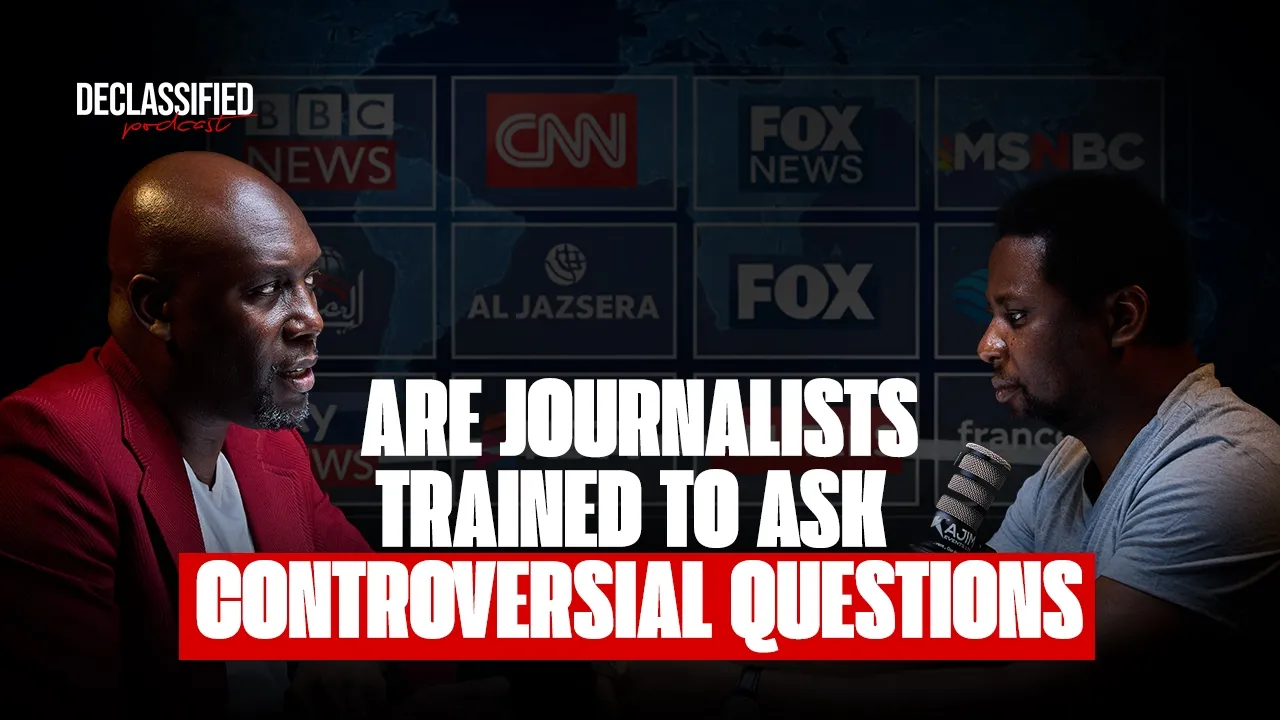
Are Journalists Trained To Ask Controversial Questions by Apostle Femi Lazarus: MP3 Download & Sermon Notes
The Broadcast Became A Targeting System
Notes/Excerpt
These notes were taken while listening and may contain some errors. Please tap any sentence twice to suggest corrections.
By holding or selecting a paragraph, you can easily share snippets to friends or on your whatsapp status directly
How Africa Is Portrayed — and Why It Is Deliberate
When a terrorist attack occurs in the United States, international media will not show blood. They will not show dead bodies. When the same kind of attack happens in Kenya or anywhere in Africa, they show everything.
This is not inconsistency. It is policy — applied selectively.
A former BBC correspondent with two decades of investigative journalism across East Africa experienced this firsthand. Covering the Westgate Mall attack in 2013 — in which over 65 people died in a siege claimed by al-Shabaab — he conducted a full interview with Kenya's interior minister, wrote his script, and submitted it through the standard pipeline. What came back from editors in another country was a fundamentally different story. Sound bites were cut to 10 seconds. The narrative was reversed. The Kenyan ground perspective was replaced with a foreign editorial one.
The person on the ground, who was present, who conducted the interview, who knew what happened — had no final say.
When he pushed back, the response was that the decision was above his pay grade. The story ran. The public was misinformed.
That experience opened a broader realization: foreign media does not try to tell African stories as Africans experience them. It tells them as it sees them — through a lens that serves a consistent narrative architecture.
Nothing paints Africa in good light. Absolutely nothing.
The Foundation of News — and What It Produces
The first lesson taught in journalism school is this: news is when a man bites a dog, not the other way around. From the first day, journalists are trained to go for the bizarre, the morbid, the sad. If a story does not contain death, despair, or destruction, it is a struggle to run.
notifications_active Stay Updated
Join the Readsermons communities for daily nuggets and new sermon alerts.
This is not accidental. It is the model. And it produces exactly what the model is designed to produce.
One week in a newsroom, the first, second, and third stories were all about death. By the end of that week, the anchors were depressed. The editor was depressed. The CEO called and asked what was happening. The honest answer: we are depressing people. Even those producing the content were being destroyed by it.
Research confirms that journalists are among the most affected by mental health issues of any professional group — not because of personal weakness, but because sustained exposure to death, violence, and human suffering without adequate debriefing causes measurable neurological damage over time.
When Journalists Are Used as a Weapon
During the Westgate attack, journalists broadcasting from the scene received images and video from people hiding inside the mall. Those people were asking for help. The footage was aired.
The terrorists were watching the same broadcast. They saw where people were hiding. They went to those locations and killed them.
The broadcast became a targeting system.
That mistake came from inexperience with a new kind of attack — one that had not been faced before. The lesson was hard. Standards had to change. But the incident illustrates how media, operating in real time with incomplete information, can become an instrument of harm.
Al-Shabaab later began reaching out to journalists directly — knowing that the media's need for footage and information could be exploited. They would send images of their attacks and expect them to be broadcasted. Some were.
Apostle Femi Lazarus
Enjoying this sermon? Browse more messages by Apostle Femi Lazarus on Declassified Podcast at ReadSermons.
How the Newsroom Pipeline Works
Understanding how a story moves from event to broadcast explains how narrative can be shaped at multiple points:
- The brief — an editorial meeting determines which stories to pursue and what angle to take. The angle is already set before the reporter goes to the field.
- The field — the reporter gathers footage, interviews, and information. But the brief determines what the reporter is looking for.
- The script — the reporter writes up the story. This goes to an editor.
- The edit — an editor checks grammar and consistency, but also whether the story serves its original purpose. Sometimes the script is changed entirely.
- The rundown — a senior editor determines placement: story one, two, three, what goes before and after the break.
- The anchor — reads the autocue. The anchor often has no knowledge of decisions made up the chain.
At any of these stages, an informant — someone inside the newsroom with outside loyalties — can flag a story before it airs. Calls get made. Stories get killed. The reporter who spent weeks on an investigation shows up for work and is told: it is not running.
This happens all the time. It is not conspiracy. It is the ordinary operation of power.
Brown Envelopes and Compromised Coverage
There is a practice in African newsrooms called the brown envelope. A source pushes an envelope across the table during a press briefing — "for your bus fare," they say. The journalist takes it. The story changes. Or disappears.
You may also like

Man Has Now Become Like One Of Us
by Apostle Femi Lazarus
The moment the envelope is accepted, the journalist is compromised. It is not a grey area.
Very few journalists take bribes. But the culture exists, and it warps coverage in ways that are difficult to trace because no paper trail is created.
The Media's Relationship with Christianity
Two decades of journalism reveal a measurable shift in how Christianity is covered compared to how it was handled when major media institutions were founded.
CNN was founded by Ted Turner, who made numerous public statements against organized religion. The network consistently supports the Democratic Party's platform. BBC began with explicit Christian programming — those standards have been entirely replaced by secular editorial values. Al Jazeera was founded by a Sunni Muslim Amir of Qatar, and that orientation shapes its coverage of Israel and Jewish communities.
- In Kenyan newsrooms, stories about pastors sleeping with congregants ran every week in prime time. The same standard was never applied to Muslim sheikhs or Catholic priests
- International funding for media programming has come with conditions — organizations seeking grants were asked to state their position on LGBTQ issues and same-sex marriage. Aligning with the funder's position was the price of the money
- Netflix and streaming content have normalized same-sex relationships through sustained repetition across years of programming — what was considered bizarre in 2010 reads as unremarkable in 2025, purely through volume and frequency
When you train a population to see something repeatedly, it becomes normal. That is not art — it is conditioning.
Deep Fakes, Manufactured Trends, and the Algorithm
The algorithm that determines what trends on social media is not neutral. Groups of people who understand how the algorithm works can make something trend between 9 and 11 in the morning on a given day, deliberately, by coordinating activity at scale.
What a person sees when they wake up and check their phone has been shaped by decisions made in rooms they have no access to. The first 25 seconds of exposure to a piece of content creates an impression that most people carry without fact-checking. That impression is then forwarded to five others. Within an hour, a thousand people's thinking has been shaped by a narrative that was engineered.
Deep fakes have made this worse. A face lifted from a podcast can be placed on a body in compromising footage and distributed before any rebuttal is possible. By the time a fact-check appears, the damage is done. This has happened to public figures. It has happened to private individuals. It will continue.
People are hiding in plain sight — and very few of them know it.
What to Do With the News
The advice from someone who has spent two decades inside the system is simple:
Take everything with a pinch of salt. Do your own research. Make up your own mind.
It is not difficult to distinguish truth from falsehood — but it requires effort. The biggest failure in the African context specifically is the absence of a reading culture. Schools trained people to memorize, not to think. Exams tested retention, not creativity. The result is a population that is easily spoonfed — by governments, by pastors, by media — because independent investigation was never cultivated.
The generation currently rising is different. They dissected a finance bill using AI and translated it into local languages so elderly women in rural areas could understand how it affected them. That is what is possible when a generation is trained to question.
The question is whether enough people will join them before the next wave of conditioning arrives.
Apostle Femi Lazarus
Enjoyed this sermon? Browse more messages by Apostle Femi Lazarus on ReadSermons.
Comments
0 comments
No comments yet. Be the first to share.
Stay updated with Readsermons
To be notified on every sermon release, join the group that suits you best:
For nuggets & Sharable snippets follow us.
headphones Media & Resources
Listen to Sermon
Download initiated! Follow us to be the first to get new sermons by Apostle Femi Lazarus.
Are Journalists Trained To Ask Controversial Questions
Apostle Femi Lazarus • 37MB
Download initiated! Follow us to be the first to get new sermons by Apostle Femi Lazarus.
Your download
is starting! 🎉
Connect with us directly for more powerful teachings.
Are Journalists Trained To Ask Controversial Questions
00:00:00 / 00:00:00